

 Shop across all brands


Nonogram Puzzles for Adults: The Perfect Screen-Free Hobby
Looking for a relaxing, screen-free puzzle hobby? Nonogram puzzles for adults combine logic and creativity. Discover why sticker nonogram booklets are the fastest-growing puzzle format.




Recommended for first purchases.


 United States (USD$)
 Canada
United States
Canada
United States
 Australia (AUD $)
 Austria (EUR €)
 Belgium (EUR €)
 Bulgaria (EUR €)
 China (CNY ¥)
 Croatia (EUR €)
 Czechia (CZK Kč)
 Denmark (DKK kr.)
 Estonia (EUR €)
 Finland (EUR €)
France (EUR €)
Finland (EUR €)
France (EUR €)
 Germany (EUR €)
 Hong Kong SAR (HKD $)
 Hungary (HUF Ft)
 Indonesia (IDR Rp)
 Ireland (EUR €)
 Italy (EUR €)
 Japan (JPY ¥)
 Latvia (EUR €)
 Lithuania (EUR €)
 Luxembourg (EUR €)
 Macao SAR (CNY ¥)
 Malaysia (MYR RM)
 Mexico (MXN $)
 Netherlands
 Netherlands (EUR €)
 New Zealand (NZD $)
 Norway (USD $)
 Philippines (PHP ₱)
 Poland (PLN zł)
 Portugal (EUR €)
 Romania (RON Lei)
Singapore (SGD $)
Romania (RON Lei)
Singapore (SGD $)
 Slovakia (EUR €)
 Slovenia (EUR €)
 South Korea (KRW ₩)
 Spain (EUR €)
 Sweden (SEK kr)
 Switzerland (CHF CHF)
 Taiwan (TWD $)
 Thailand (THB ฿)
 United Kingdom (GBP £)
Vietnam (VND ₫)
United Kingdom (GBP £)
Vietnam (VND ₫)

Relaxing, classic, pixel by pixel

Layered stickers, patterns, special finishes

Ages 6+, easier, bold designs

Logic based sticker puzzle booklets
A nonogram is a logic puzzle where you fill in cells on a grid based on number clues along the rows and columns. As you solve each row and column, a hidden picture is revealed. Think of it like a crossword puzzle, but instead of words, you get art.
Nonograms go by many names. You might have heard them called picross puzzles, griddlers, paint by numbers (the logic kind, not the painting kind), or Japanese crosswords. They were invented in the late 1980s independently by two puzzle creators: Non Ishida in Japan and Tetsuya Nishio. The name "nonogram" stuck, and the puzzle format has been growing in popularity ever since.
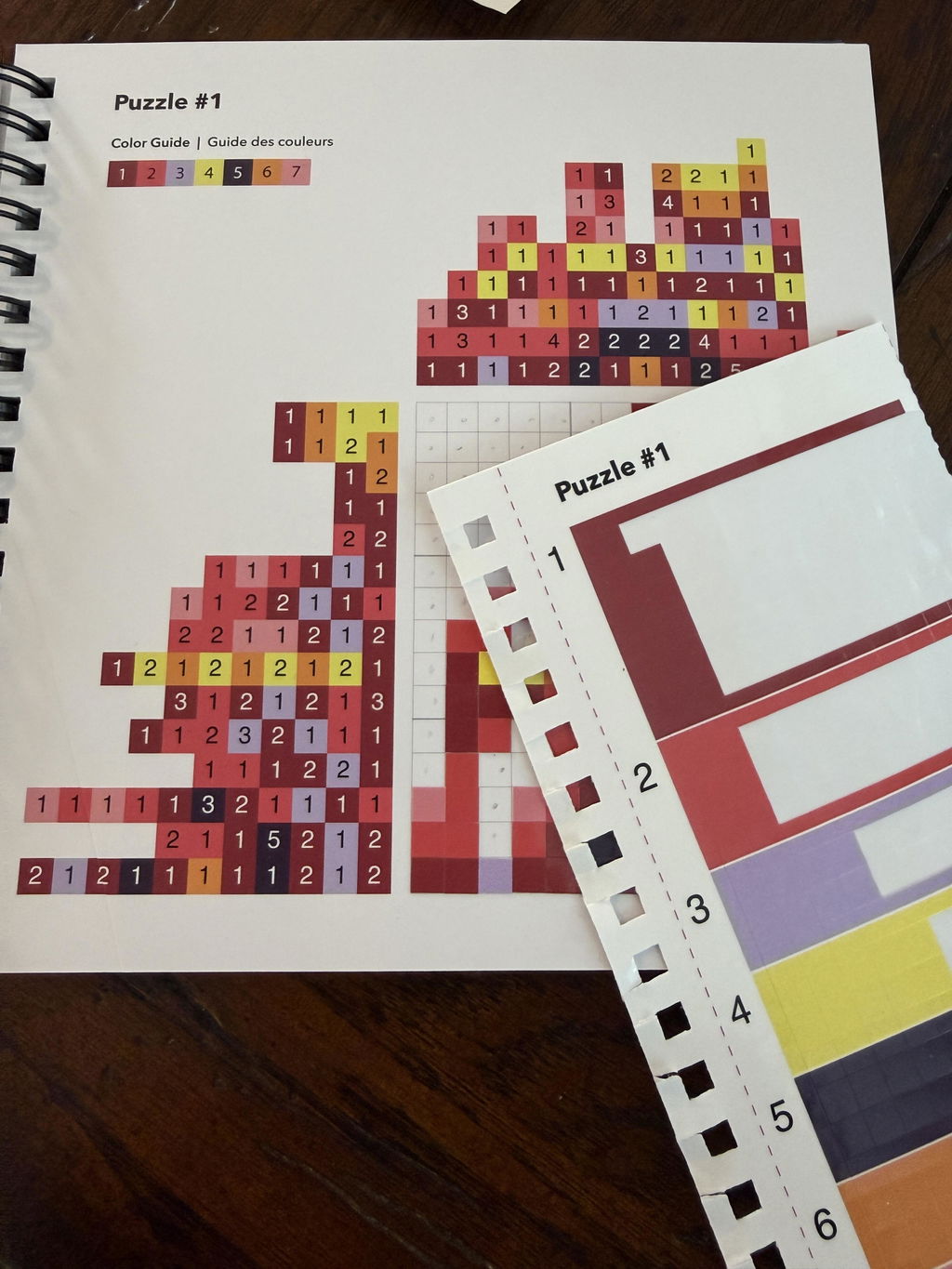
Every nonogram starts with an empty grid. Along the top of each column and the side of each row, you will see a series of numbers. These numbers tell you how many consecutive cells to fill in that line, and in what order.
For example, if a row shows the clue "3 1", that means somewhere in that row there is a group of 3 filled cells, then at least one empty cell, then 1 filled cell. Your job is to figure out exactly where each group goes by cross-referencing the row clues with the column clues.
The beauty of nonograms is that they are 100% logic. No guessing required. Every puzzle has one unique solution, and you can always reach it through deduction alone.
Nonograms have exploded in popularity over the past few years. Market research shows they are the fastest-growing puzzle format globally, with a projected growth rate of 10.6% per year through 2034. Here is why people love them:
Both nonograms and sudoku are logic puzzles, but they scratch very different itches:
| Feature | Nonogram | Sudoku |
|---|---|---|
| Goal | Reveal a hidden picture | Fill numbers 1-9 in a grid |
| Visual reward | Yes, you get pixel art! | No, just numbers |
| Skill type | Spatial reasoning + logic | Number logic |
| Difficulty range | Easy (5x5) to very hard (25x25+) | Easy to expert |
| Creative element | High. Art is the reward. | None |
If you enjoy sudoku but want something more visual and creative, nonograms are the natural next step.
Here is where things get really fun. Traditional nonograms have you filling in squares with a pen or pencil. Sticker nonograms take it to the next level: instead of filling in cells, you place tiny colored stickers on the grid. As you solve each puzzle, the stickers build up into a beautiful piece of pixel art.
Pixyls invented this format. Our nonogram sticker puzzle booklets combine the satisfying logic of nonograms with the tactile, meditative experience of sticker-by-number crafting. Each booklet includes multiple puzzles, clear instructions, and all the stickers you need. Every design is illustrated by real artists (never AI), and the finished pieces make beautiful keepsake art.
Don't just take our word for it. Here is what nonogram fans think after trying sticker nonograms for the first time:
"This is where I discovered nonograms. I tried them first in pencil form, which I do enjoy but not as much as using stickers. It's like combining two amazing hobbies into one!"
Circus Nonograms
"I have long been a fan of nonogram puzzles and have completed both physical puzzles and digital puzzles on my iPad but this is now by far my favourite way to do them."
Nonogram Booklet Set #1
"I've been doing nonograms in an app for a while but doing them in real life with stickers was amazing! Definitely a different kind of challenge!"
Jungle Animals Nonograms
"I am addicted to picross, so finding these books was serendipitous. I loved completing them and the little images they revealed are very cute!"
Farm Animals Nonograms
Ready to try? Here is a quick beginner strategy:
Whether you are a puzzle veteran or a complete beginner, nonograms offer a uniquely rewarding experience. And if you want to take it beyond pen and paper, explore our sticker nonogram booklets. They are mess-free, portable, and perfect for relaxing at home or on the go.
Welcome to your new favorite puzzle. 🧩